Orthopaedic Surgery in Milan, Italy: A Guide for European Patients
Orthopaedic surgery in Milan for European patients: who it suits, how to verify a clinic, how treatment is structured, costs in context and planning the stay.

Milan is an unusual destination for orthopaedic surgery. It is not a low cost market, and it does not present itself as one. What it offers instead is a dense concentration of specialist hospitals and clinics, a long tradition of orthopaedic and sports medicine practice, and a city that is genuinely easy to live in for a few weeks while you recover. For patients with complex knee, hip or shoulder problems who want to combine specialist care with a manageable stay in a place they might actually enjoy, it has real arguments in its favour.
This guide is written for European patients considering orthopaedic treatment in Milan. It covers who Milan suits and who it does not, how to verify a clinic, how treatment is typically structured for an international patient, what costs look like in context, and how to plan the trip so that the recovery has somewhere sensible to happen.
Aurevon Health is an international medical tourism intermediary and not a healthcare provider. Italy is one of our eight operating markets. Nothing in this article is medical advice, and we do not assess suitability or recommend particular procedures.
Why Milan, and who it actually suits
The strongest reason to consider Milan is specialisation. The city and its surrounding region are home to centres that handle high volumes of joint reconstruction, sports injuries and complex revision work, including clinicians who treat professional athletes. For a patient with a straightforward knee replacement, that depth may be more than you need. For someone with a failed previous operation, a complex cartilage problem or a shoulder that has not responded to two years of conservative care, access to that expertise is the point.
The second reason is practical access. Milan is served by three airports and sits within a few hours of most of western Europe by air, and by train from Switzerland, France and parts of Germany and Austria. For a patient who wants a companion to be able to visit easily, or who wants the option of returning for a review appointment without a long journey, that connectivity matters.
It does not suit everyone. Italy is not a discount market, and patients whose primary motivation is a substantially lower surgical fee will usually find better value in Turkey or the Czech Republic. Milan also operates on Italian timelines, which can feel slower than northern European expectations for administration, however excellent the clinical work.
Verifying a clinic before you commit
Italy has a mixed provider landscape: public hospitals, private accredited facilities, and private clinics with varying levels of accreditation. The distinction matters, and it is not always clear from a website. Ask which legal entity would provide your treatment, and ask for its accreditation status in writing.
Italian regions accredit and monitor healthcare providers, and many private facilities hold accreditation from recognised bodies in addition to regional authorisation. Ask which accreditations apply, who issued them and when they were last reviewed. A clinic that can answer precisely, and provide documentation, is demonstrating that it understands the question.
- The legal name and address of the treating facility
- Regional authorisation and any additional accreditation, with dates
- The name and registration of the surgeon who will operate
- Annual volume for your specific procedure
- Whether the facility has an intensive care unit on site
- Languages spoken by the clinical team, not only the sales team
- What documentation you receive at discharge, and in which language
Be cautious with any clinic that presents international accreditation as its only credential while declining to give the surgeon's name. Patients are treated by people in buildings, and the person matters more than the plaque.
How treatment is usually structured for international patients
The typical pathway begins with a records review: imaging in DICOM format, a clinical summary and a list of what has already been tried. A first consultation follows, either remotely or on arrival, and in a well organised facility it includes a physical examination and a review of the imaging by the operating surgeon before any plan is finalised.
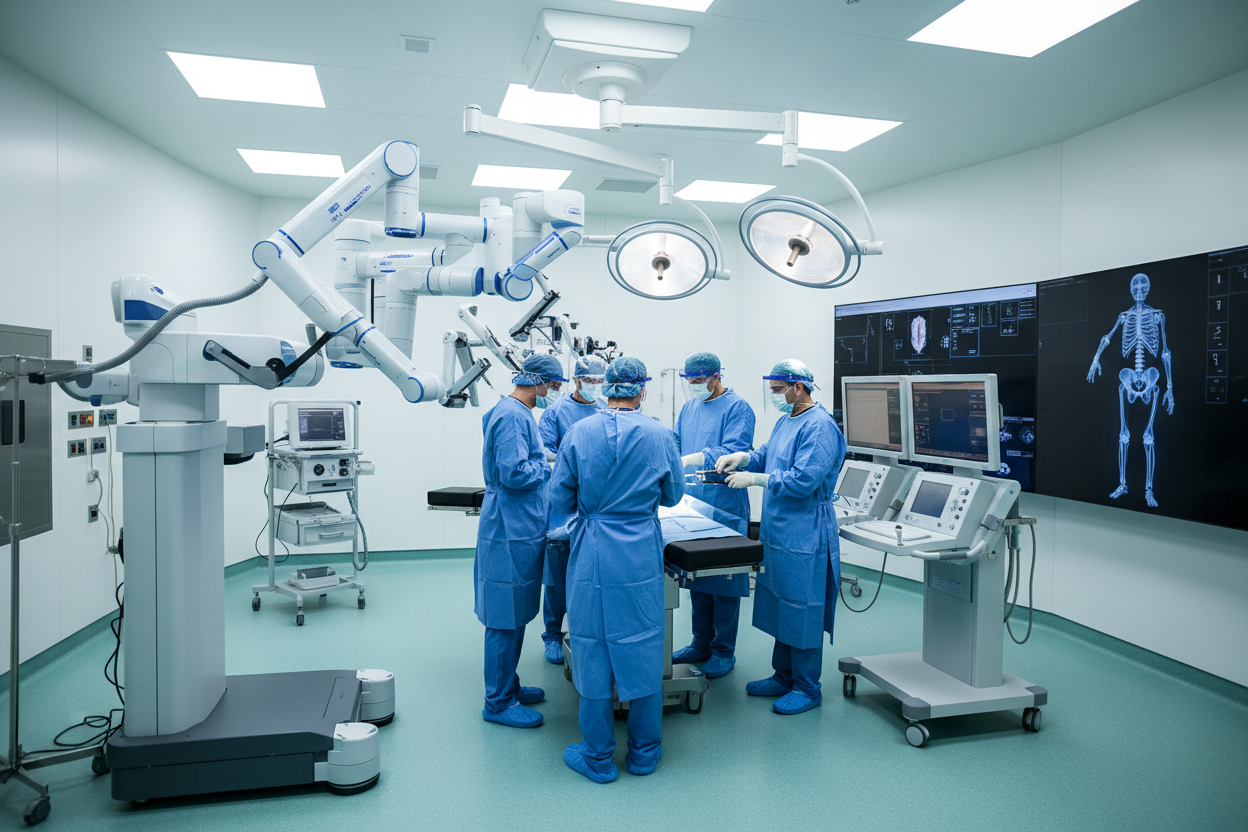
For most primary joint replacements, patients are admitted on the day of surgery or the day before, stay between three and five nights depending on the procedure and their progress, and are discharged with a written plan and a review appointment. Complex revision work and shoulder procedures often require longer stays. Day case arthroscopic surgery is common for appropriate cases.
Rehabilitation usually begins in hospital and continues on an outpatient basis. This is the part international patients most often under plan: an outpatient physiotherapy schedule in Milan for two or three weeks means staying in the city longer than the surgical stay, which changes both the budget and the accommodation requirements.
Language and communication
Many Milanese clinicians speak English, and larger private facilities employ interpreters. That is not the same as clinical communication being conducted in your language throughout. Ask specifically who will explain the operation, who will obtain consent, and who you will speak to at two in the morning if something goes wrong. Consent in a language you do not fully follow is a real problem, not a formality.
Costs in context
Orthopaedic surgery in Milan is priced closer to northern European private rates than to the lower cost markets, and patients should approach it with that expectation. A primary hip or knee replacement at a private accredited facility is a significant investment, and complex revision surgery considerably more. Comparing it against a Turkish or Czech quote as though the two were the same product will produce a misleading conclusion.
The fair comparison is against private treatment in your own country, on an itemised basis. Milan often comes out competitive against private rates in Germany, France or the UK, particularly for complex work where the alternative at home involves a long wait or a less specialised team. Against public provision in your home country, the comparison is not price at all. It is time and choice.
All figures should be quoted in euros and confirmed as fixed for a defined period. Ask for the itemisation described in any good quote, and then add the trip: flights, accommodation for you and a companion for perhaps three weeks, physiotherapy, and local follow up. The clinical fee is usually less than half of the real total.
Planning the stay around the recovery, not the surgery
The most common planning error in Milan is booking accommodation for the hospital stay and then discovering that the rehabilitation phase is longer. Patients who need outpatient physiotherapy for two or three weeks should plan for that from the start.
Choose accommodation on the basis of accessibility rather than charm. A ground floor apartment or a building with a reliable lift, a step free entrance, a walk in shower and a location within a short taxi ride of the clinic will do more for your recovery than a beautiful flat in a historic building with a narrow staircase. Many central Milan buildings are charming and entirely unsuitable for the first fortnight after a hip replacement.
Consider the season. Milan is hot and humid in July and August, which is uncomfortable in a compression stocking and difficult for walking practice. Late spring and early autumn are kinder. Winter is manageable and the city is quieter, though short daylight hours can weigh on mood during a recovery that already limits activity.
Practicalities of the city
Milan is compact and its public transport is good, but the metro is not uniformly accessible and the historic centre is full of cobbles. For the first weeks after joint surgery, taxis and pre booked transfers are the realistic option, and they should be budgeted rather than treated as an occasional expense.
Pharmacies are widely available and staff are generally helpful, but prescription rules differ from your home country and some medications you take routinely may be handled differently. Bring an adequate supply of regular medication in original packaging with a copy of your prescription, and ask the clinic in advance about anything you will need after discharge.
Interpreters, mobility equipment hire and accessible transport can all be arranged, but each requires lead time. Ask the clinic what it organises and what you must arrange yourself. The answer is a good indicator of how much experience the facility has with international patients.
What to ask a Milan clinic specifically
Some questions are worth asking of any clinic. Others are particular to Italy and to a market where public and private provision sit side by side and the paperwork matters.
- Is the facility regionally accredited, and can I see the documentation?
- Who is the named surgeon, and what is their registration number?
- Is the implant registered and traceable, and will I receive its details?
- What is the exact planned length of stay, and the cost of extra nights?
- How many outpatient physiotherapy sessions are included?
- Will the operation note and discharge summary be provided in English?
- What is the process if I need urgent care after returning home?
- Does the facility have an on site intensive care unit?
Ask also how the clinic handles a complication that requires a return visit, since return travel from another country is a practical cost that rarely appears in a quote. A clinic that has a defined answer has thought about international patients as patients rather than as bookings.
Getting home, and what happens next
Flying after joint surgery requires medical clearance, and most surgeons advise a defined waiting period with clot precautions during travel. Milan's airports are well equipped to provide assistance, but it must be requested in advance, and mobility equipment usually needs to be declared to the airline.
Before you leave, collect the operation note, the implant details, imaging taken after surgery, the discharge plan and a letter for your local physiotherapist. Ask for these in English and, if possible, in the language of your home country. Then confirm that your local physiotherapist is ready to take over and that your first appointment at home is already booked.
Most patients find that the first review at home, around two to three weeks after return, is where the transition either works or does not. Having that appointment arranged before you travel removes an anxious gap, and it gives your local clinician something concrete to work with alongside the Milan documentation.
Frequently Asked Questions
Is Milan a good destination for orthopaedic surgery?
Milan is strong for specialist and complex orthopaedic work, including revision joint surgery and sports injuries, at specialist centres with high volumes. It is not a low cost market, so patients seeking the lowest price usually find better value elsewhere. It suits those prioritising specialist expertise and short travel distances.
How much does hip or knee replacement in Milan cost?
Private accredited facilities in Milan price closer to northern European private rates than to lower cost markets, and complex revision work costs considerably more. Compare itemised quotes against private treatment at home, and add travel, accommodation for three weeks and physiotherapy to reach a realistic total.
Do Milan clinics speak English?
Many clinicians in private facilities speak good English and larger hospitals employ interpreters. Ask who will obtain consent and who handles out of hours contact, and request documentation in English. Confirm the arrangement in writing rather than assuming it will be available when needed.
How long should I stay in Milan after joint replacement?
Plan around the rehabilitation rather than the hospital stay. Inpatient time is typically a few nights, but outpatient physiotherapy often continues for two or three weeks. Many patients stay three weeks in total, and flying requires medical clearance and clot precautions.
Can I use my European health insurance in Italy?
Italian public healthcare operates under European arrangements for necessary treatment during a temporary stay, which is not the same as planned elective surgery. Private treatment is paid for directly or through private insurance. Confirm coverage with your insurer before travelling rather than assuming reimbursement.
What is the best time of year for treatment in Milan?
Late spring and early autumn are the most comfortable for recovery, with moderate temperatures and good walking conditions. July and August are hot and humid, which is unpleasant in compression stockings, and winter brings short daylight hours. Consider your own recovery needs rather than peak travel convenience.
The information provided in this article is for general informational purposes only and does not constitute medical advice. Aurevon Health is a medical tourism concierge service and is not a medical provider. We do not diagnose, treat, or recommend specific medical procedures or treatments for individuals. Always consult a qualified medical professional before making any decisions about your health or healthcare. Individual outcomes vary and cannot be guaranteed. Aurevon Health does not endorse or guarantee the services of any specific clinic, hospital, or healthcare provider.